Sesame Asparagus

Click here to view recipe.

"Smart" Phone Photo Op with Eileen in our animal bathrobes!

Let me begin by saying that this is a remarkable story, a true story about a surreal experience I had at the end of March. My friend Eileen and I planned an overnight trip to Portland, Oregon…just a quick getaway to eat, shop and sight-see. Portland is a three-hour drive from Seattle and it had been years since my last visit. For the record, I lived there for a year between1974 and 1975; it has, of course, changed and grown since that time and is now a fun, vibrant city.

I investigated, copied parts of a New York Times article about Portland and booked a room at the Hotel Vintage Plaza – a lovely, midsize hotel close to downtown, the Pearl district and great restaurants. Lia, the guest services representative of the hotel, was most helpful in suggesting things and places we might enjoy prior to and during our visit.

Let me be clear that I often discover places on my own that are not written up in newspapers or magazines – places that are fantastic for food or shopping. This ended up being the case in Portland. Through talks with shop owners, we were introduced to 23rd Street (LOVED) and we found a number of enchanting stores right around our hotel, such as the Portland Mercantile and several small boutiques. Neither place was ever mentioned in our research. We did read about the Pearl District and spent hours traipsing from clothing and home decor stores to art galleries. Frankly, we didn’t really love any of the stores we perused as we found them too contrived and young for a couple of 60-somethings.

Food Cart Falafel!

However, Lia suggested we try the food carts which literally line an entire square block and learned that these “food cart colonies” are clustered all around town. What a concept – like a mobile food court! I sampled falafel and Eileen chose Mexican food, which we took to the park nearby. For dinner, we made reservations at Andina, a Peruvian restaurant close by our hotel that my friend Kathy loved. Considering that Kathy is a foodie in every sense of the word, I always trust her restaurant recommendations. Again, the restaurants suggested in newspapers didn’t strike my fancy as much as great Peruvian ethnic food!

We took a short taxi ride to Andina and spent two hours sampling six various Peruvian tapas. The menu was peppered with several quinoa dishes, breads, salads, and desserts. I was happy to discover a number of dishes featuring passion fruit including a delicious salad called Ensalada Verde Peruana – greens topped with hearts of palm, cotija cheese and asparagus drizzled with a passion fruit salad dressing that was so good I asked about how to prepare it. Our server informed me that the chef used about 20 various ingredients for this dressing! (No, I did not get the recipe.) My favorite tapas was composed of thinly sliced red and golden beets flanked on one side with a ribbon of tasty, green vegetable puree and on the other with shaved, sesame scented, pickled vegetables. By the end of the meal we were tired and gave up plans to listen to jazz, returning to our hotel by taxi.
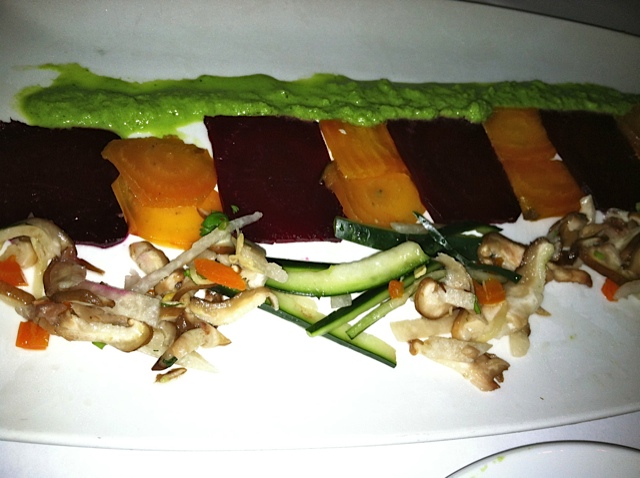
Beautiful Beet Salad

The following morning we decided to wander around downtown, but Eileen could not find her cell phone. I called from my “smart” phone to her antiquated flip phone, surmising that if it rang we would find it buried among our belongings. No dice. We even got in the car and I again called her number. No ring. Eileen wasn’t that worried because she uses this $40 phone only for emergency contact and rarely makes calls and certainly has no important data stored. However, if it were truly lost, she would have needed to call her carrier, cancel the number, buy a new phone…you know the drill. No fun. Both of us are incredibly careful about organization and do not misplace our belongings, so the missing phone started to drive me crazy.

Lo and behold, a few minutes passed when my phone rang and Eileen’s number popped up. “You’re calling me!” I chirped, then realized her CELL PHONE was calling my cell phone. A taxi driver, in very broken English, told me he found a cell phone in his taxi. It took several tries and I finally understood the address where he told us he’d wait for us to retrieve the phone. Little did we know that his location was 30 plus minutes from downtown – over bridges, down boulevards, and into the bowels of the Portland suburbs. Along the way I fantasized that this man would become Eileen’s future husband – the man of her dreams.

My trusty but annoying portable GPS (who I nickname “The Lady”) gave us directions and miraculously we found the location and the taxi driver, wearing red pants as he described. He was young, toothless, and very sweet. Eileen was so grateful – she hugged the taxi man and told him what a kind, wonderful person he was. The whole ordeal exhausted us and we could not believe what had happened. It took us at least fifteen minutes to realize that this man in the red pants had been our taxi driver who transported us the previous night to Andina!

Anyway, you’re probably wondering what all of this has to do with cooking and I must admit – absolutely nothing. However the Peruvian salad I enjoyed reminded me that asparagus is in season in the Pacific Northwest, so I thought I’d share one of my favorite, easy salads that I make this time of year: marinated asparagus. Back in my catering days, I used to serve this with salmon and noodle kugel. You’ll find this lovely tender vegetable in the spring, and the marinade has so few ingredients but brings asparagus to life. The asparagus and dressing can be made separately a day or two ahead of serving, so this is my spring “go to” dish when I attend a potluck or have company for dinner.
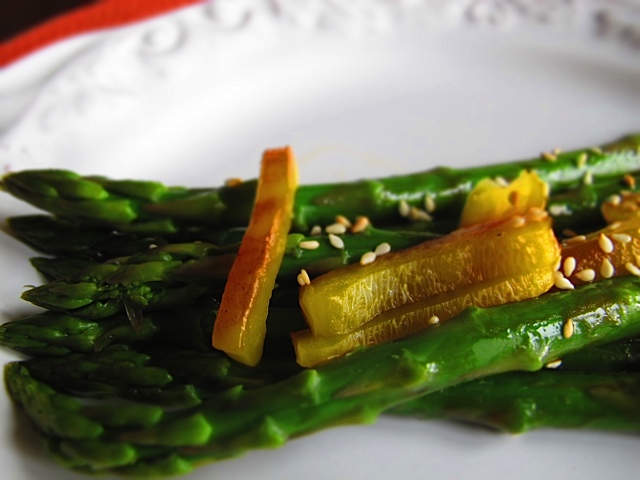
Marinated Asparagus

Marinated Asparagus

Serves 6

pf-icon2

Ingredients:
  • 1 ½ lb of fresh asparagus
  • 2 tsp sesame oil + 2 tsp canola oil
  • 2 Tbsp tamari sauce
  • 1 Tbsp brown sugar (or to taste)
  • 1 Tbsp toasted sesame seeds and/or 2 Tbsp of slivered roasted bell pepper, yellow or red
Instructions:

Snap off the ends opposite the tips of the asparagus. Unless the stalks are pencil thin*, I peel the stems with a veggie peeler (if thin, you can omit peeling), put in large deep sauté pan with an inch of water. (My sauté pan is 11 inches in diameter.) Bring to a boil, and lower to medium heat for 5-7 minutes until the asparagus is bright green and barely tender when pierced with a fork. Leave the top off the fry pan when doing this.  Remove the stalks of asparagus and put into ice water and let sit for 5 minutes. This stops the cooking and quickly cools the vegetables. Place the stalks onto a dry dishtowel, making sure the water is absorbed, and then put in a sealed bag or container.

Mix the rest of the ingredients into a small jar and taste for sweetness. I often make a double batch of the dressing which keeps for a couple of months refrigerated.  When using it for this recipe, it takes very, very little dressing.  Roll the asparagus in the dressing right before serving or the dressing will make the asparagus turn a much less vibrant color.

To serve, place on a serving platter and top with toasted sesame seeds. I usually garnish this with slivers of roasted red and yellow pepper.

Share
Posted in North America, Vegetables | Tagged , , , , , , | 2 Comments

Meatball Matzo Ball Stew

Click here to view recipe.

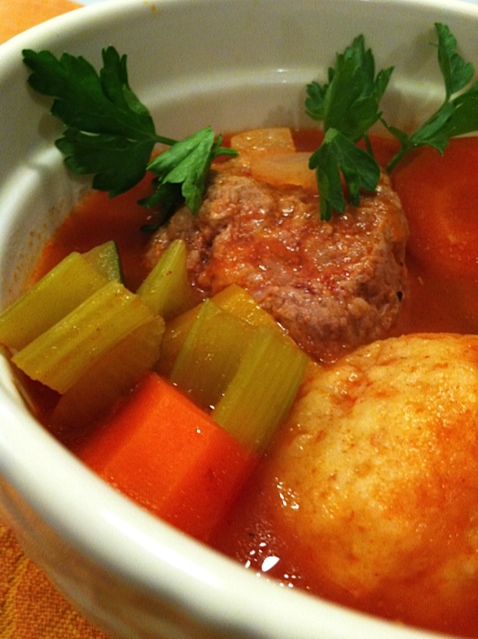
Meatball Matzo Ball Stew

Passover is almost upon us, and I’m looking forward to traveling to the Midwest to be with my family for the first Seder Saturday night. Since today is the first Wednesday of the month, I am featuring a simple recipe that I make year round but always during Passover, when wheat and leavening is not to be consumed.

Everyone who has ever sampled this one pot dish raves about the flavors. It is a warm, comforting meal-in-one, and I include a lot of vegetables in the pot along with the meat and matzo balls. In our house we call this “old man food” because we’ve found that older men love the familiar flavors and textures of the stew – it reminds them of food they ate in their youth!

You don’t have to be Jewish or observe Passover to make this stew. It is super easy and you’ll have dinner for several nights!

Hearty Meatball Matzo Ball Stew

Serves 8 or more

pf-icon2

Ingredients
  • 2 lb very lean ground chuck (I always use grass fed organic meat)
  • 2 large eggs
  • ¾ c matzo meal ( or ½ c breadcrumbs if it is not Passover)
  • 1 ½ tsp fine sea salt
  • 1/3 tsp fresh ground black pepper
  • 1 ½ c zucchini, cut into ¾ inch cubes
  • 5 carrots, peeled and sliced (2 cups)
  • 1 large parsnip, peeled and sliced (1 cup) or you can use all carrots and eliminate parsnips
  • ½ yellow bell pepper, seeds removed cut into ½ inch dice
  • 3 stalks celery, sliced ½ inch (3/4-1 cup)
  • 1 large chopped onion, peeled and cut into 3/4 inch dice (2 cups)
  • 1 ½ tsp salt
  • 1 cup tomato sauce
  • 2 cups water
  • 1 cup tomato juice
  • 1 tsp sugar
  • 1 recipe matzo balls
Instructions:

Mix first 5 ingredients, and gently divide the meat mixture evenly to make 12-14 meatballs, about 2 inches in diameter. Place these on a waxed paper-lined, flat tray while you prepare the stew.

Prep and place all the cut veggies in a 6 quart soup pot then add the tomato sauce, tomato juice, water and sugar (I add sugar or honey whenever I used canned tomatoes to cut down on the acidity and find it makes a big difference). Stir well to combine.

Top the veggie/liquid mix with formed raw meatballs. Bring to a boil, reduce heat and cover to let it slowly simmer for 35 minutes. Baste the meatballs every 10 minutes with juice, being careful not to break them apart.

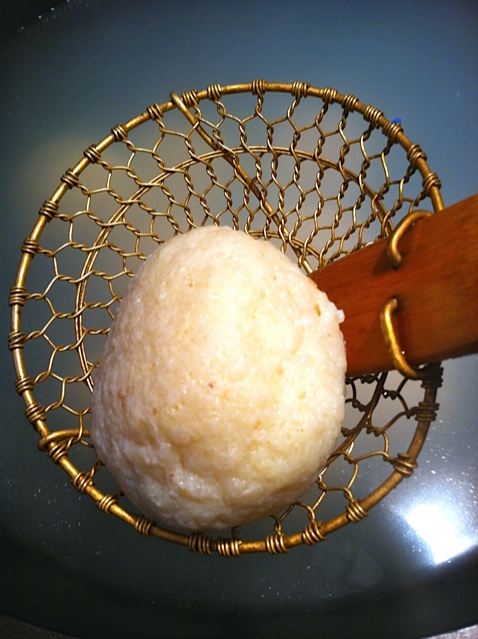
Meanwhile, make one recipe of matzo balls (from a package or from scratch, depending on your time frame and how industrious you’re feeling). A package of Manischewitz matzo ball mix needs to have 2 eggs and 2 tablespoons of oil added, then formed into about 10 1-inch diameter balls. Handle the mixture gently with wet hands – do not over handle. After the raw dough has been refrigerated for 25 minutes, place the uncooked matzo balls into an 8-quart pot of rapidly boiling water. Make sure the pot is very large as the matzo balls tend to expand. Immediately cover the pot, turn down the heat but be sure the water continues to boil. Do not lift the lid until 25 minutes have passed.

Matzo Ball

After 25 minutes, remove the lid of the matzo ball pot and gently remove the cooked matzo balls and place them on top of the cooked meat ball/veggie stew. Cover the pot containing everything now and cook 10 minutes longer, basting at least once so the balls do not become dry. It thickens so be careful not to burn it!

When serving, be sure to top with some chopped parsley for color and consider serving along with a nice, simple green salad.

Note: once the meat balls and matzo balls are gone, I often repurpose the hearty liquid broth by adding more vegetables and even a scoop of cooked quinoa (also allowed during Passover since quinoa is not a grain). At times other than Passover, this is marvelous with fresh sliced challah dunked into the liquid stew. Steamed potatoes also make a good addition. YUM!!

Share
Posted in Soups | Tagged , , | 4 Comments

Fruit Crisp

Click here to view recipe.

Beautiful Hayley

If any of you are wondering what to get a new mom after the baby is born, think about delivering a home cooked meal. Mind you, I only do this for special ladies like my daughter’s best friend Hayley, who lives in Seattle. Hayley is my only hope to lure my daughter back to this city, I’ve known her for ages, and I love her like one of my own.

Hayley recently had her second baby and I clearly remember when I rang the doorbell to deliver dinner after the birth of her firstborn. Both she and her chef-husband expressed so much gratitude for the fairly pedestrian meal I brought. (Incidentally, if you bring a meal for those who cook on a regular basis, do not ever worry about what to make or how your food will taste. It’s the best gift to have someone cook for you!) For this second pregnancy, we had brunch together two days before her daughter Mia’s arrival and carefully planned what type of food she would want – so I knew I would arrive with a dinner they would love.

A Feast Fit for a New Family

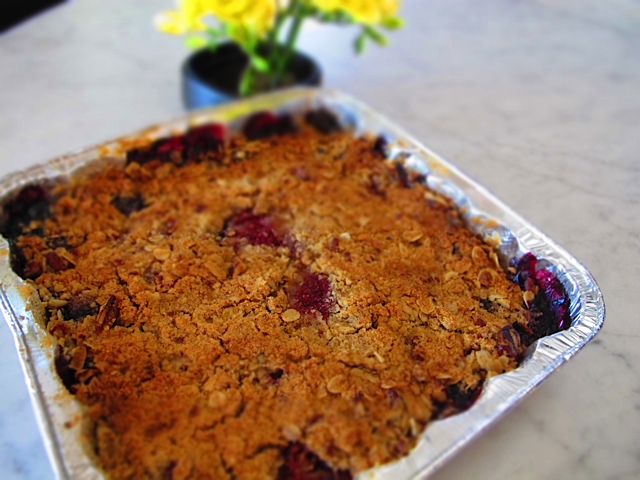
Hayley gave birth to Mia on the last Monday morning in January and by Friday I was packing disposable pans with Belizean chicken, brown rice, seasonal greens with basil vinaigrette, homemade challah and a berry crisp right out of the oven. I didn’t realize it at the time, but I’ve written about both the chicken and challah right here on My Global Kitchens website – so you know they have extra special meaning to me! It was such a delight to meet little Mia. And I promise I behaved myself – I didn’t stay long OR kidnap the baby.

Hayley told me about an internet site called Meal Train where someone who wants to organize meal delivery can offer this as a “sign up” sheet for family and friends. Brilliant! Why didn’t I think of that?? I believe we should all keep this in mind for anyone in need of nourishing meals: an elderly relative, a sick friend, a new neighbor, anyone. Just..do…it!

The dessert I brought them, a berry crisp, has a story of its own. Hayley served crisp at her wedding and LOVES this dessert. I always keep a bag of crisp topping and frozen berries and/or peaches ready for a quick, wonderful finale. Sometimes I put a little fruit in a two person oven dish for me and my husband, and if I have unexpected company or am not in a mood to fuss over something complicated, this is my go-to, end-of-the-meal surprise.

Fruit Crisp - Right Out of the Oven

Fruit Crisp

Serves 6-8

pf-icon2

Topping Ingredients:*
  • 2 cups regular flour
  • 2 cups packed brown sugar
  • 2 sticks butter, cut each stick into 8 pieces
  • 1 cup rolled old fashioned oats
  • 2 cup walnuts or pecans, coarsely chopped
Filling Ingredients:
  • 5-6 cups fruit (see options below)
  • 3 Tbsp flour
  • ½ cup granulated sugar (or less, depending on the sweetness of the fruit)
  • ½ teaspoon ground cinnamon

* makes enough for four-brownie size square pans, about 8 cups. I normally use 2 cups of this per 8-9 inch square pan

Instructions:

Preheat the oven to 375 degrees.

For the crisp topping – combine the 2 cups of flour and the 2 cups of brown sugar into the bowl of the food processor fitted with a metal blade, and pulse to mix. Add the butter and use the pulse button to combine the butter with the flour. Stop pulsing when mixture is the texture of moist crumbs. You could also do this (cut the butter into the flour and sugars) manually with two table knives.

Place the flour/sugar/butter mixture into a large bowl, and add the oats and nuts. Use your fingers to work everything together gently.

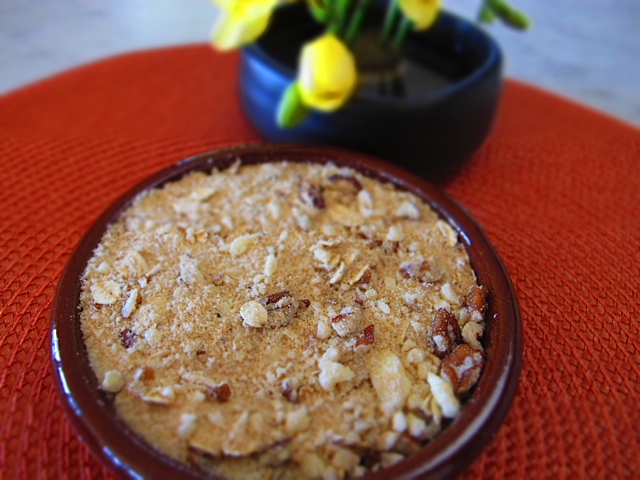
I then remove 2 cups of this for the 9 inch crisp I am making and freeze the rest!

Crisp Topping

Combine filling ingredients in a bowl to mix well, then place mixture into a buttered baking pan.

Place 2 cups of the topping on top of the fruit, covering the entire exposed filling; especially around the edges.

Bake for 45-60 minutes in the center of the oven or until you see fruit juices bubbling up through the topping. You may want to place foil or a larger rimmed cookie sheet underneath the crisp while baking it to catch the juice.

Cool on a wire rack. This is best served slightly warm with a scoop of vanilla bean ice cream, crème fraiche or whipping cream.

Ideas for the fruit (I have used different combos of the following):
  • Strawberries and rhubarb
  • Mixed berries
  • Thinly sliced (1/4 inch) peeled apples (I mix golden delicious and granny smith)
  • Peeled & sliced peaches
  • Unpeeled & sliced plums
Share
Posted in Dessert | Tagged , | 2 Comments

Ceviche by the Sea

Click here to view recipe.

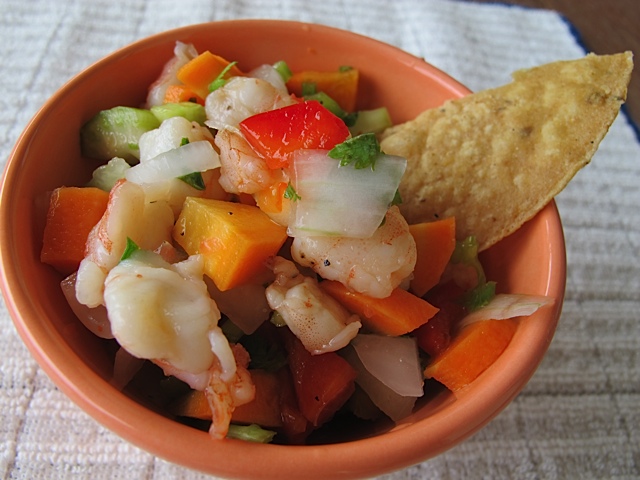
Refreshing Ceviche

Ceviche: How much do I love thee? Let me count the ways: I love you in a big wood bowl with a spoon for dinner, I love you as an appetizer with homemade corn chips, I can eat you day after day after day.

When we first started building our home here in Belize 12 years ago I tried ceviche in every restaurant in town! A fishing guide of ours, “Skinny,” bragged that he made the best ceviche around and he demonstrated his technique for my hubby. He used a large amount of fish and lots of fresh, local vegetables. We love his recipe and make it every single time we are down in Belize and for each and every visitor. It’s a must-eat in our home and has almost become a religious experience!

If you can chop, you can make ceviche. Nothing else quite hits the spot on a hot, hot day – something about the saltiness, the crunchiness and the spiciness speaks to me when it is 85 degrees outside. I think its appeal is due in large part to the big hit of citrus. Belizean ceviche is known for an abundance of freshly squeezed lime juice. The acid from the limes changes the texture of the fish, yet bacteria and parasites can remain so it is ultra important to begin with washed, clean ingredients.

Chop Chop!

The quantities below provide a guideline, but feel free to add more or less of anything to your own taste. For example, I usually add more onions and celery for crunch. And be sure to use the freshest seafood available!

Belizean Ceviche

Makes ~8-10 cups

pf-icon2

Ingredients:
  • 1 pound of seafood-this can be medium peeled shrimp, snapper, grouper, cod, lobster, conch…anything white.
  • 8 medium sized limes, juiced
  • 1 large carrot
  • 1 red onion (or white sweet onion)
  • 2 stalks of celery
  • 1 red or yellow bell pepper, seeded
  • 1 large tomato, seeded
  • 1 cucumber, peeled and seeded (in the U.S. I use English cucumbers, which do not need peeling)
  • 1 bunch cilantro, washed and finely chopped (about ⅓ cup packed once chopped)
  • Salt and pepper to taste (it takes lots of both)
  • ½ habanero pepper, seeded and minced very fine or a hefty amount (~ 1 Tbsp) of habanero hot sauce such as Marie Sharps. Wear gloves if you are handling fresh habanero peppers!

Ingredients

Instructions:

Use a large ceramic or glass bowl to hold the chopped ingredients. First, dice whatever seafood you use into ½ inch pieces. Place in bottom of bowl and juice enough limes so the juice barely covers the seafood.

Meanwhile dice carrots, onion, celery, pepper, cucumber and tomato into small, uniform pieces, about ¼ inch. Mince cilantro and add all of this to the bowl of seafood. Mix well, add hot sauce or habanero and salt/pepper.

Place a dish on top to cover the ceviche and leave it in the refrigerator. Stir well every hour. Less dense fish (i.e. white fish) takes less time to be ready and denser seafood (i.e. conch, lobster and shrimp) takes longer. I really prefer using a fairly dense fish that can hold up to the lime juice – I find the more delicate white fishes get “mushier.” Taste after 2 hours and inspect to see if the fish is no longer opaque. The mixture will lose some volume as it juices. Add more salt, ground black pepper or habanero sauce at the end to taste.

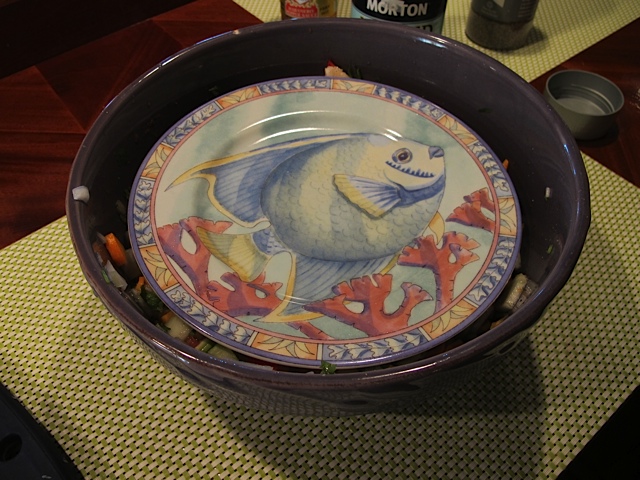
The Perfect Plate to cover the bowl of Ceviche while it "cooks" in the refrigerator!

We like to serve this with fresh tortilla chips and, of course, a nice cold beer or Margarita. And when we’re feeling extravagant, we’ll put together a batch of freshly made Caipiringas made with rum instead of Cachaca – the perfect accompaniment to my favorite Belizean treat!

Share
Posted in Central America, Fish & Seafood | Tagged , | 4 Comments

Onion Infused oil

Click here to view recipe.

Magestic Machu Picchu

As you have likely discovered, I travel a lot. So it should come as no surprise that we accumulate a ton of airline miles – which makes traveling to exotic locales much more viable. About eight years ago, our accrued mileage was begging to be used so we decided to explore a new area in South America. We were in the mood to explore a new culture and get out into nature. Machu Picchu had always been a dream destination – so we cashed in our miles and headed to Peru. As luck would have it – we timed it perfectly because we were set to depart in January – a mere two weeks before the Machu Picchu hiking trail closed for the year.

I honestly don’t know what we did before the Internet. It makes it so easy to research and plan travel. After just a few hours of perusing various travel sites about Peru, we decided on a 2 ½ week trip encompassing three varied areas: Machu Picchu, Manu (the rain forest), and Arikeepa (in the Southern part of the country). To make our lives easier, we decided to engage a tour company that specialized in the region and, after viewing many websites and noting comments from former clients, we settled on Go South Adventures. Wayne began email correspondence and discovered that this adventure outfit was based in Ballard, Washington – a stone’s throw away from our home in Seattle. Talk about a small world!

The tour company did a marvelous job of providing guides in each location who were intimately familiar with the local cultures. We were able to avoid touristy shops, Americanized restaurants and ho-hum hotels. In other words, we could do this trip OUR way in OUR time frame and be able to tweak our trip if need be. Just our style.

We barely saw Lima when the plane landed at midnight and after a brief rest at a local motel, we departed the following morning to the gateway city of Cuzco. This is common practice and helps people acclimate to the altitude before traveling to Machu Picchu. But more than an intermediate resting stop, Cuzco is a beautiful city. The area has a significant Spanish influence and the streets were lined in cobblestones.

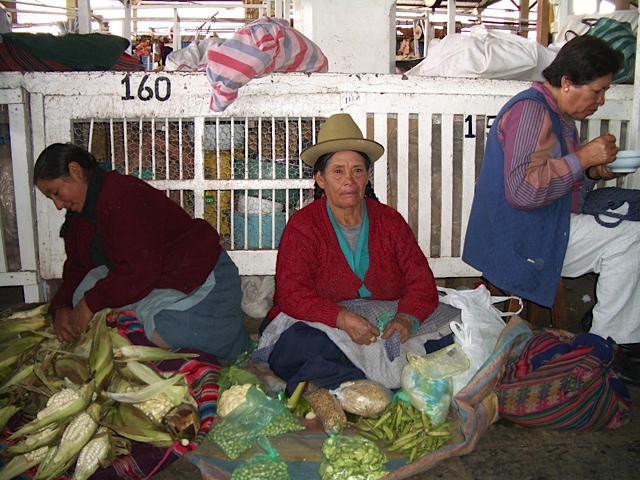
Locals & Llamas in Cuzco

I read in our guidebooks about the public market and was instantly intrigued. We were warned that the market could be highly dangerous, but how could I not experience the huge public marketplace??? Our guide Juan assured us that he would keep an eye out for potentially dangerous situations there and off we walked to the market without purses, backpacks, or fancy clothing. Of all the central marketplaces in the world, this was THE most exciting and diverse. Many of the vendors were wearing native colorful garb – and believe me, it was not to impress the tourists. I suppose most people follow the guidebooks’ advice and steer clear of this market. In fact, we didn’t see any American or even European travelers anywhere near this magical spot. What a shame!

Peruvians grow a huge variety of fruits and vegetables, many of which were on display at the market. We gazed at heaps of various potatoes, numerous types of dried and fresh beans and a variety of meats including baby llama carcasses used for religious ceremonies. Incense filled the air as we walked among countless food stands and stalls bursting with clothing, kitchenware and handmade items. We lingered for more than three hours – it was heaven. The people are so friendly and welcoming. And the food … oh, the food!

At the Marketplace

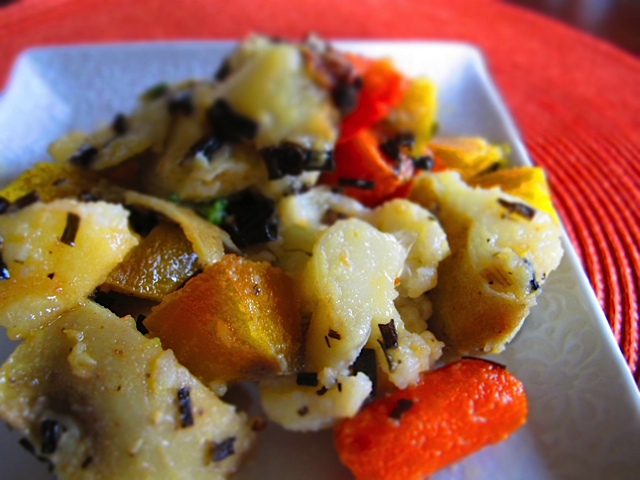
One of the best parts of our travels throughout this wonderful country was the bounty of fresh produce. I’m a vegetable fanatic and the multitude and variety was simply incredible. At one of the restaurants I noticed a fresh onion flavor emanating from the plate of roasted potatoes and multicolored fresh beans. So, naturally, I asked the waiter about the dish. The secret? Spring onion infused oil! The vegetables were served at room temperature and were cooked and seasoned to perfection.

To be frank I love roasted vegetables of any kind, but I do tire of the same old preparation, particularly in the winter. This recipe is a close rendition of what I ate in Peru, and I make it now and then – especially in the winter when root vegetables are in season and I’m looking for a way to jazz them up.

Steamed Vegetables with Onion Oil

Spring Onion Oil

pf-icon2

Ingredients:
  • 1 cup vegetable oil such as canola
  • 3 bunches green onions (also known as scallions or spring onions)
  • 1 teaspoon sea salt
Instructions:

Wash and pat dry the green onions. Trim off the roots and the very ends of the green stalks and cut the remaining onions into ⅛ inch slices.

Over high heat, warm the oil in a quart saucepan until very hot. Quickly, with an oven mitt on your hand, add the sliced onions and salt all at once. The oil splatters so have a lid ready to cover the pan just after you add the onions. Continue to fry the onions 2-3 minutes as the edges become brown and the onions get crispy. Turn off the heat and let the scallions continue cooking in the hot oil so that they become golden to dark brown.

Cool to room temperature in a glass jar, and then keep in the refrigerator for up to a month. Use to flavor steamed vegetables or as a condiment for salads, pastas, sandwiches and roasted meats. My favorite preparation is to quickly steam small halved new potatoes, cauliflowerettes, carrots, parsnips, broccoli flowerettes, and cubed yellow pepper. After the vegetables are blanched I plunge them into ice water, and then dry them well on a kitchen towel. Into a casserole dish they go with very little of the onion oil, salt and pepper. It’s a Peruvian-style vegetable dish that cannot be beat!
By the way, I used some of this onion oil in making my crackers and it gave them an unbelievable flavor!

Share
Posted in Central America, Condiment, Odds & Ends | Tagged , , , | Leave a comment

Basic Bolognese

Click here to view recipe.

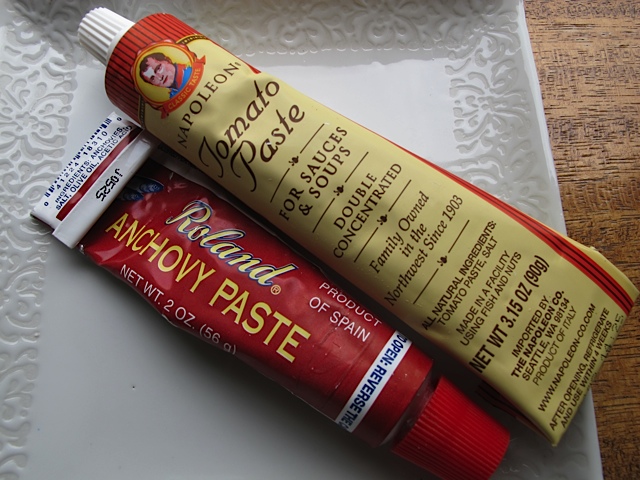
Tomato & Anchovy Paste

It’s the first Wednesday of the month again. So it’s time to keep things simple. And what could be easier than food in a tube? I know … surprising words coming from me – especially considering my penchant for fresh ingredients. However I have come to rely on these two kitchen staples: tomato paste and anchovy paste. I am so grateful that I learned about these nifty tubes. Prior to this discovery I was forever opening cans of tomato paste only to have it spoil before I could use the entire amount. Ditto the tins of anchovies, which I use only infrequently in Caesar salad dressing or other recipes in need of a hit of salty flavor. So stocking tubes of tomato and anchovy paste is, for me, a no-brainer.

One of my most treasured recipes featuring tomato paste is Bolognese sauce. This is one of my favorite things to make in March, when the wind kicks up and it’s cold outside. Plus, in keeping with the simplistic theme, this recipe is very, very basic. The ingredients can be found almost anywhere – I’ve even made this in foreign locales when I have access to a kitchen. It’s a slow cooked meat sauce that can be used to top any kind of pasta (my favorite is fresh pappardelle from Delaurenti in Pike Place Market in Seattle… but you can use any kind you like). And, best of all, the house smells heavenly when it’s cooking away on the stovetop.

Bolognese Sauce

Serves 4-5

pf-icon2

Ingredients:
  • 1 brown onion, peeled and diced ¼ inch
  • 2 cloves garlic, finely minced
  • 1 large carrot, peeled and diced ¼ inch
  • 2 celery stalks, diced the same size as the carrots
  • 2 medium roma tomatoes, seeded and diced small
  • 3 Tbsp olive oil
  • 1 lb lean ground chuck or lamb
  • 1 tbsp. tomato paste
  • 8 oz beef stock or vegetable stock (I have even used chicken stock in a pinch)
  • Salt and pepper to taste
Instructions:

Heat a large straight-sided pan (at least 8 inches in diameter with deep sides) over medium-high heat.

Add the oil until it is hot, then add in the diced vegetables.

When they have browned a bit, add the meat. Keep stirring and breaking up the meat with a wood spoon. When it is no longer pink and lightly browned, add the tomato paste, stock, salt and pepper – stirring well to combine.

It should cook on low heat for at least one hour, with the lid on, and should be stirred from time to time. Taste and adjust seasonings.

This recipe can easily be doubled or tripled, and it freezes well for up to 4 months.

Share
Posted in Meat, Pasta, Sauces | Tagged , | 4 Comments

Lamb Tagine

Click here to view recipe.

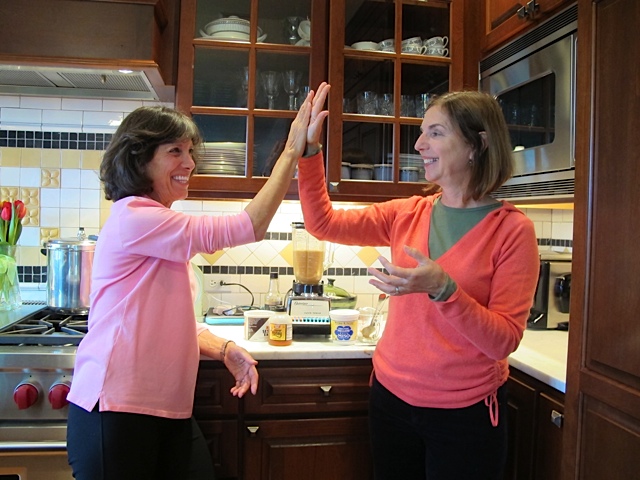
Cooking in my kitchen with Toby

Like many of you, I love spending time with my friends – yet I find everyone is busy going in many different directions. Between work, the gym, travel, knitting, golf, bridge, and everything else on the list, it is tough to find quality time with my special girlfriends. Whenever we can, we’ll carve out an hour to take a walk, have lunch, or go to the movies. One of my favorite ways to connect, however, is hanging out in the kitchen.

Since I arrived in Seattle nearly 32 years ago I have made an effort to cook with some of my dearest friends. Sometimes this involves baking special foods for the holidays, sometimes it revolves around a two-person project, and oftentimes it is simply just for fun. I’m hard pressed to sit still for too long (not my favorite trait) so when I make a date with a friend to cook together, it gives me time to catch up with what is going on in our lives AND be very productive at the same time.

A few caveats here: #1 I am very, very bossy in the kitchen and need to be in charge of how things are made, how to chop ingredients, what order to add them….on and on. The word “chef” translates into “chief” after all and I haven’t lost my Captain’s license from my catering days.  In addition to my needing to be the “boss,” I can only cook with those who share my propensity for a tidy kitchen – a messy workspace makes it next to impossible for me to enjoy my cooking experience. I can imagine that these, shall we say, compulsive tendencies may be off-putting to some. But my friends who know me well understand and embrace my controlling ways! Plus we always split the cost of the ingredients and inevitably end up with incredibly delicious dishes.

On a recent Monday I got together with my friend, Toby. Lucky for me, she likes to do the grocery shopping so I emailed her a very specific grocery list and she arrived armed with all the ingredients needed to make lamb tagine and a lovely miso orange salad dressing. We had barely two hours to be together and not only did we make the stew and the dressing, but I taught her how to make my famous seeded crackers and we threw together a terrific hearty lunch with lots of great leftover food. We even managed to get the dishes washed and the floor swept – not bad for two hours!

All the Ingredients

I would encourage you to find a cooking partner or partners on occasion. Decide who you can work with – someone has to be “in charge” and you have to agree on what to make, how long you are willing to spend cooking, who shops etc. You’ll be amazed at how much more gets done and what a fun activity this can be for friends to share.

Lovely Lamb Tagine

Pressure Cooker Lamb Tagine

Serves 4-6

pf-icon2

Ingredients:
  • 1 tablespoon olive oil
  • 2 pounds boneless lamb stew meat, cut into 1 ½ inch cubes
  • 1 large brown onion, peeled and chopped into 1-inch pieces
  • 3 large cloves garlic, minced fine
  • 1 cup dried apricots (I used organic non-sulphured apricots)
  • 1/3 cup white raisins
  • ½ cup blanched whole almonds
  • ¾ tablespoon fresh gingerroot, peeled and minced
  • ½ teaspoon ground cinnamon
  • 1 tsp salt or to taste (I needed more at the end)
  • 10 grinds of ground black pepper
  • 1 cup water
  • Fresh squeezed orange juice from 1 large orange
  • 1/3 cup packed fresh mint leaves
Instructions:

Heat oil in large 12-inch sauté pan over medium-high heat. Add lamb cubes and brown on all sides, about 5 minutes per batch. Transfer browned lamb to plate with slotted spoon.

Add onion and garlic to the liquid in the pan and sauté 3 minutes to soften. Place lamb, onion and garlic and the rest of the ingredients into a pressure cooker. Cover cooker, securing lid; bring to high pressure. Reduce heat to maintain high pressure* and cook 20 minutes. Let pressure release naturally, 10 to 15 minutes.

When pressure has dropped, carefully remove the lid away from you. Test meat; it should be fork-tender. If it’s not tender, replace the lid and cook under high pressure 5 minutes longer, then quick-release pressure.

Notes:

Believe it or not, the almonds in this recipe stay crunchy and give the stew some texture.

I served this thick stew on top of jasmine brown rice pilaf with lots of carrots and a butter lettuce salad. Orange slices and biscotti make a nice, light dessert.

*This could be done on top of the stove in a 4-quart pot but it will take a lot longer and most likely you will need to keep adding water so it doesn’t dry out. 20 minutes in the pressure cooker, people. Come on!! Try it, you’ll like it. If you live in the Seattle area come over and I’ll convert you to pressure cooking.

Share
Posted in Meat | Tagged , | Leave a comment

Caipirinhas

Click here to view recipe.

Beautiful Beach & Boardwalk in Sitges

After a week in Barcelona filled with intense museum going, architectural tours, walking for eight hours each day and eating overpriced food, I needed a break. My brilliant husband reviewed our guide book and stumbled upon a town called Sitges – a beautiful village nestled along the coast only 45 minutes from Barcelona. We packed our bags, walked to the train station, purchased tickets and shortly arrived at this beach town that many refer to as the “St. Tropez of Spain.” Mountains, warm sunny weather, expansive beaches, an azure ocean. Very low key, with great people watching. How bad could that be?

It turned out to be an unexpected and magical interlude for our vacation. We stayed in a quaint hotel along the beach that was clean and conveniently located right near San Sebastian beach. We meandered all over the town and hiked up the cliffs overlooking the ocean. It was paradise!

Our Lovely Hotel

There were at least eight outdoor restaurants surrounding us, all serving fresh seafood and local Spanish fare. We found one of our favorites by accident. La Mentha, a small, authentic pub, was almost hidden down a winding cobblestone street. Spaniards tend to eat dinner around 10pm or even later which just didn’t work for me given the nine-hour time difference from Seattle. Much to my delight, La Mentha was actually serving food around 8pm! After the day’s activities, we were starved and ready to eat. Everything was prepared simply – just the way I like it. Seasonal fish, fresh vegetables and a light salad all tasted fantastic!!

And then there was the bar. They advertised Caipiringas, Brazil’s national cocktail and one of my favorites. Our Italian bartender told us he made them much like they do in Brazil. Bingo!

Caipiringas!

He muddled and squeezed fresh limes, combined it with turbanado sugar and homemade sweet and sour mix. With all the crushed ice, it quenched my thirst and tasted like the real deal. Salted peanuts were served as an accompaniment. We returned every day while in this lovely town and consistently ended our brunch or dinner with one of these homemade refreshments.

Mandarin Caipirinha (The orange was my wanna-be-bartender husband’s twist!)

Ingredients:
  • 1 lime, cut into 6 wedges
  • 1 heaping Tbs. turbinado (raw) sugar (granulated sugar works but the turbinado sugar is pretty readily available and more authentic)
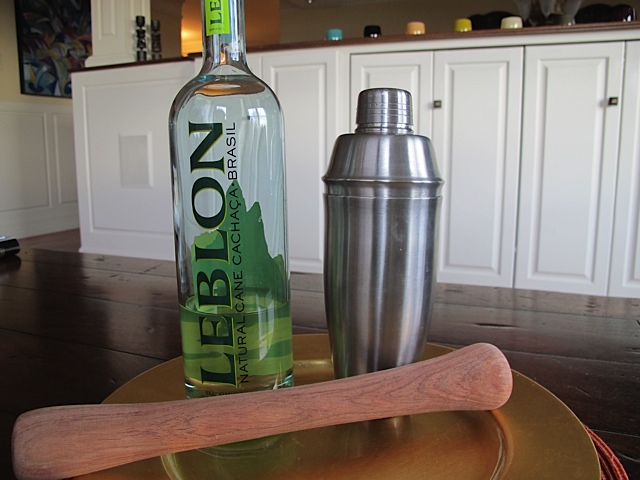
  • 2 ½ oz Cachaca* (ours came from the neighborhood state liquor store)
  • Juice of 1 satsuma orange (or juice of a ½ of a large juice orange)
  • Finely crushed ice to fill the tall martini shaker ⅔ full (about 2 ½ cups)

* If you can’t find Cachaca – you can substitute light rum. But I highly recommend hunting down Cachaca!

The Essential Ingredients

Instructions:

Muddle the lime and sugar in the bottom of a martini shaker (follow this link to learn how to “muddle”). This releases the juices and oils from the limes.

Add Cachaca, and satsuma or orange juice.

Fill the shaker ⅔ full of crushed ice (we actually pound ice inside a cloth bag with a mallet!)

Shake well and pour all the liquid along with the limes and ice into a 16 ounce tall glass and fill the glass to the top with more crushed ice. Garnish with a lime wedge.

Stir and sip…it gets better as the ice melts!

Share
Posted in Beverage, uncategorized | 2 Comments

Mujadrah

Click here to view recipe.

Healthy Food for Teens

I volunteer throughout the year for various organizations and causes; I am not one to lick envelopes or address invitations because I would rather use my skills and talents to really make a difference. So on a recent dark, cold Monday night while the rain fell endlessly, I drove over to the University Lutheran Church near the University of Washington. My friend Marilyn had asked me to help her team cook for homeless teens and I was thrilled to be able to help.

A few of the volunteer servers

The first group of workers arrived around 5 o’clock; one woman had groceries loaded up with all the ingredients we needed for dinner, and we all pitched in to help empty the car and transfer everything to metal carts. Through the door, up the elevator and into the commercial kitchen we went, chattering all the while. Everyone donned their aprons and began working on the meal, which had to be ready to serve by 6:45pm. One woman cut up fruit and vegetables, a team of two constructed the enchilada casserole and nachos, someone else created a beautiful salad and I had the distinctive job of making Mujadrah, an Egyptian lentil/brown rice/caramelized onion dish.

Around 6:45pm the next group of volunteers arrived and they set up eating tables and the buffet tables with plates, cutlery, and the food. The young adults were already in line for dinner and I stayed long enough to watch them enjoy the meal. I was so happy to see them partaking in a hearty, healthy meal on such a dreary, wintry night.

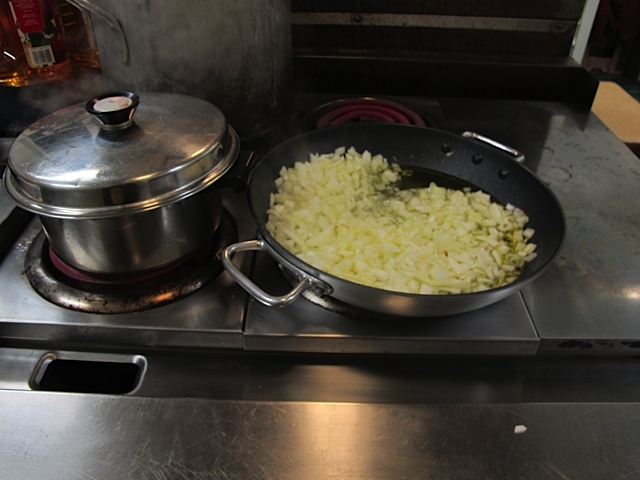
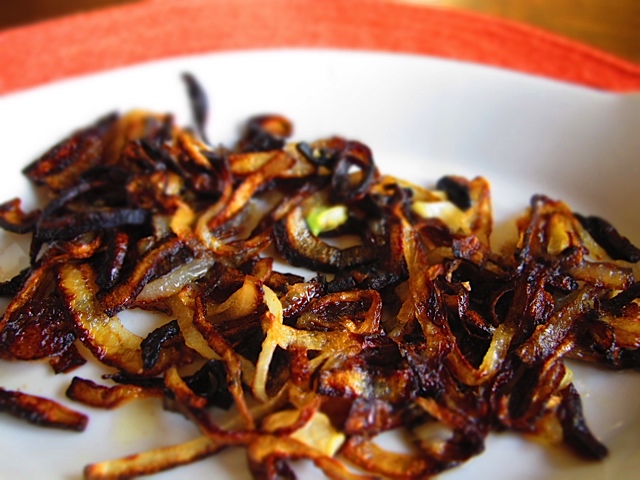
Mounds of Onions Sauteeing for Mujadrah

Teen Feed organizes meals every Sunday through Thursday night, relying on various groups of volunteers to shop, cook and serve dinner to teenagers who live on the streets, are homeless or who cannot afford to buy food. We cooked and served a delicious dinner of cut up fruit, vegetables with hummus, green salad, Enchilada casserole, Nachos, Mujadrah, cookies, milk and juice. This type of meal would be tough for these teens to afford, and many of the fruits and vegetables we served were organic. Nearly 70 kids served themselves mounds of food, chatted happily while eating and left appearing to be very satisfied.

This was my second time cooking for these youth and I’ll absolutely do it again! The only downside was that I totally smelled like onions (I diced 10 of them) when I got home. But considering I had a warm home to return to – I am not complaining.

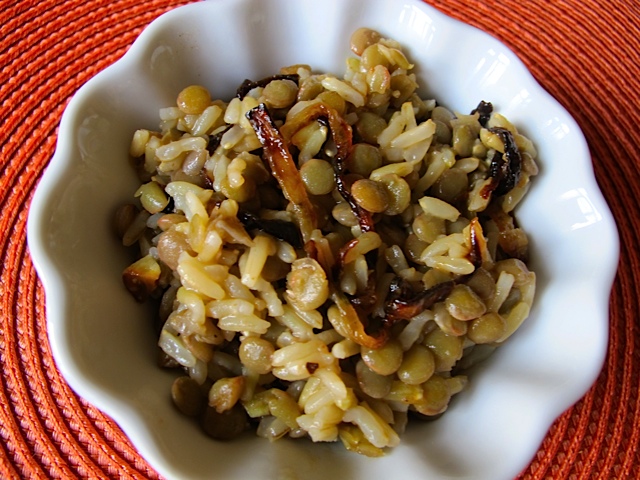
Mujadrah

Egyptian Mujadrah (brown rice, lentil, and caramelized onion pilaf)

Serves 8

Ingredients:
  • 1 large brown skinned onion, peeled and cut into thin half moons
  • 2 cloves of garlic, peeled and finely minced
  • 1 tsp. fresh ginger, peeled and finely grated
  • 1/2  tsp. dried ginger
  • 3 Tbsp.  vegetable oil
  • 1 cup brown lentils
  • 1 cup brown basmati rice
  • Salt and pepper to taste
  • 1/2 of a small bunch flat leaf parsley, stems removed and finely chopped
Instructions:

Heat the oil on medium high in a 10 inch skillet (cast iron pan works best) and add the onions. Turn heat to medium and stir onions occasionally until they are caramelized and very soft, between 20-30 minutes. Add the fresh and the dried ginger and the minced garlic toward the end of the cooking time. You might need to add additional oil if it seems dry.

Delicious Carmelized Onions

Meanwhile, cook the brown rice with water in a sauce pan or pressure cooker according to the package directions. Simmer the lentils with water separately according to your usual method. The lentils need to be watched so they are not undercooked but don’t overdo it either or they get mushy.

Combine the cooked brown rice and cooked lentils with the caramelized onions, and more salt and pepper to taste together in a large bowl. Taste and adjust seasonings. Top with some chopped parsley.

This tastes great warm or even at room temperature, and left over Mujadrah is great reheated the following day. It’s even vegan and gluten free!  I serve it with a large Greek vegetable salad and fresh fruit at home.

Share
Posted in Africa, Side Dish | Tagged , | 2 Comments

Honey Oatmeal Bread

Click here to view recipe.

Daughter Rachel with horse & buggy near Kalona

I grew up in Iowa, a place of simplistic beauty. My daughter and her family still live in eastern Iowa so I often travel back to the place where I spent almost 20 years. Last spring we took a short field trip (literally… it was a trip through the farms and fields) to Kalona, Iowa – a twenty-minute drive from my daughter’s house. I used to visit this beautiful area almost 40 years ago when I worked as a nurse in Iowa City. These were the days before the farmer’s market movement so I was always on the hunt for fresh cheese, produce and eggs.

This charming rural town is home to a large number of Amish families and contains many locally owned shops, bakeries and restaurants. A subgroup of the Christian Mennonites, Amish churches provide rules that include simplicity in the way their followers live and dress and instruct their congregants survive without the ease of modern technology. My grandson Zay was fascinated with the horse drawn buggies, the mode of transportation for observant Amish families even during sub-zero Iowa winters and sweltering, humid summers. Amish women wear dark colored, long garments, sensible shoes and white or black head coverings and the men have long beards and they wear brimmed hats. The most devout in this community do not use electricity, and they certainly do not own cell phones or computers!! They utilize oil lamps in their businesses; all machinery for farming and manufacturing is run by manpower. Many Amish men and women allowed me to photograph their businesses and horse drawn carriages but humbly stated that they did not want their pictures taken!

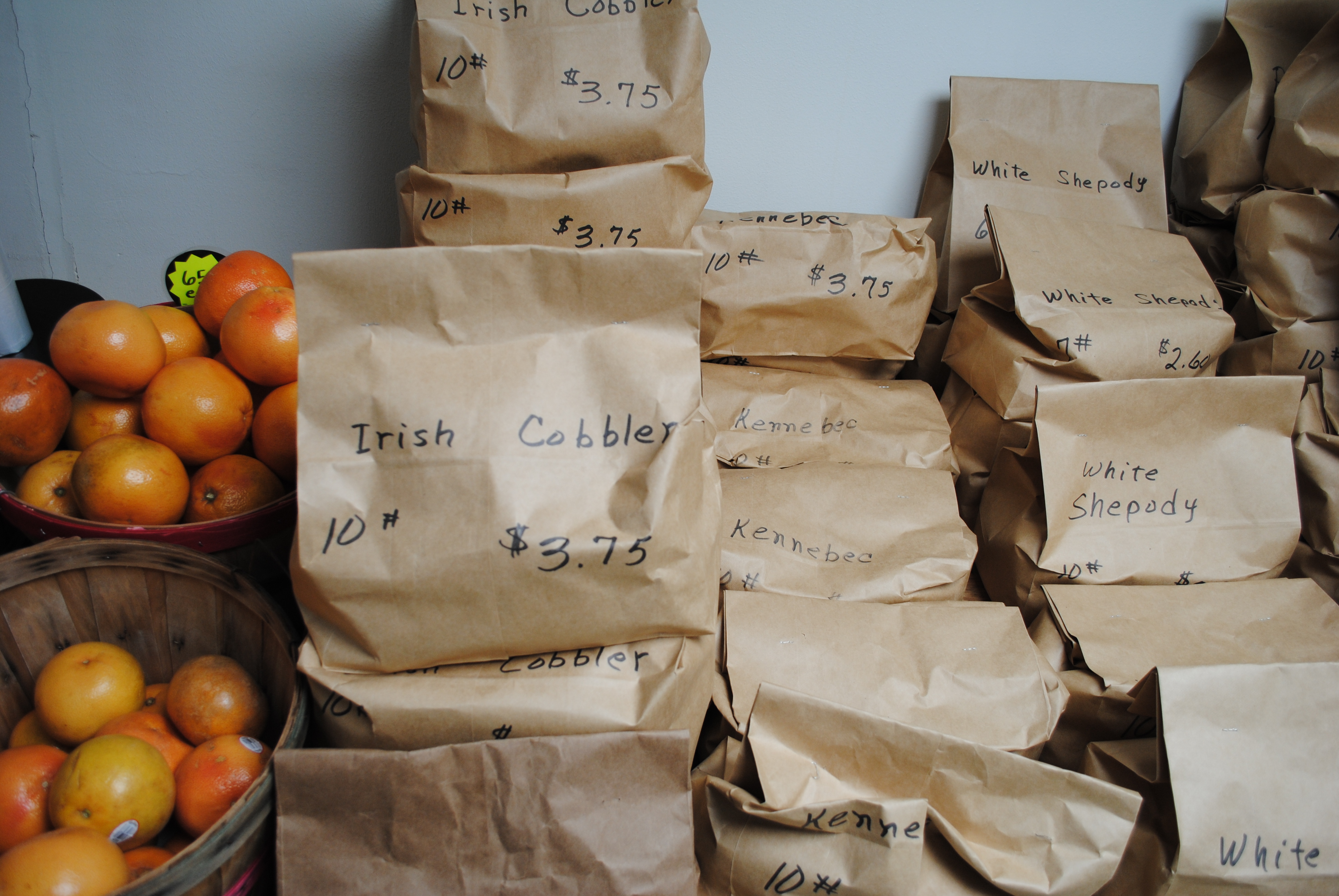
During this trip to Kalona, we began at the cheese factory and watched the cheese curds (AKA squeaky cheese) being stirred. The curds were fairly bland, buttery yet salty and definitely squeaky. We bought a small bag of them and ate most of our stash in a short time. They were perfect “kid” food – easy to grab and nutritious to boot. Next was the Stringtown Grocery where we bought bulk mini cinnamon chips (which I use for my scones), local pastry flour and small vegetable starts for leeks and onions. There were more than 30 varieties of potatoes packaged by hand in paper sacks, many with names that were new to me.

Potato varieties at the Grocery

Our final stop of the morning was the Golden Delight Bakery! In addition to beautiful homemade berry and cream pies, breads and pastry, the establishment sold freshly made glazed doughnuts. The women allowed me to photograph the work space where they were getting ready to bake pecan logs, apple pies and rolls. Without electricity the room was exceedingly quiet and peaceful and the women chatted amicably with each other. They courteously answered my many questions and eyed us with amusement. On the way out we purchased doughnuts, ate them outside on a picnic table then returned home a much-needed nap.

Zay with his grandpa eating his glazed doughnut at the bakery

Once I had a chance to rest I decided to use the freshly-purchased flour to bake some of my family’s favorite Honey Oatmeal Bread (recipe below) and soon the kitchen smelled almost as good as the Bakery in Kalona.

What a morning! And such a great reminder that foodies like me don’t need to travel to exotic locations when in so many instances a short drive down a country road will reveal an entirely different world – sometimes a world that has stood still for over 100 years.

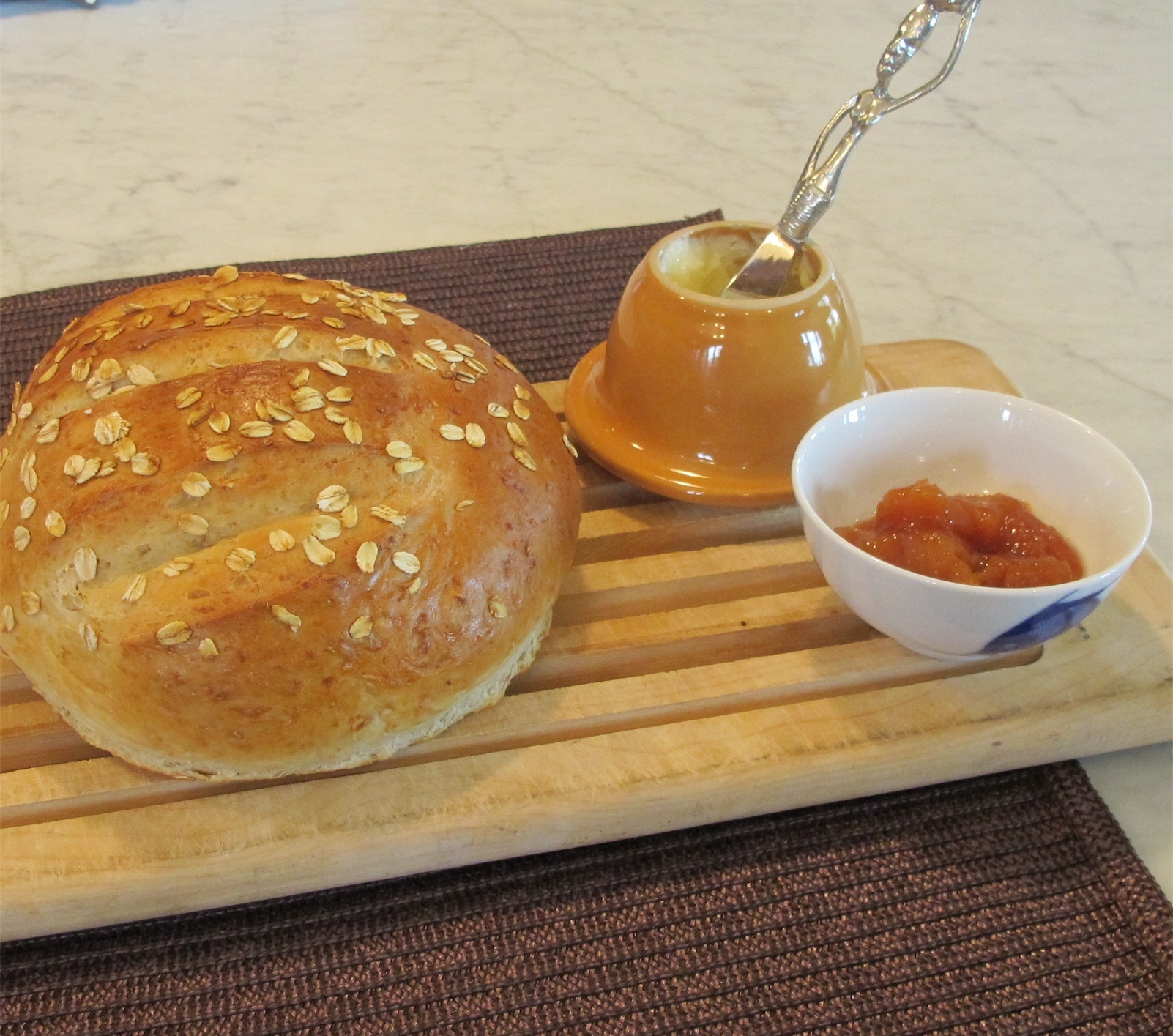
This is a sweet tasting, very moist bread that is loved in our family. It’s perfect for toasting and I love to serve it with fresh butter and a bit of honey. And it freezes very well for up to a month.

Freshly baked bread

Honey Oatmeal Bread

Makes 2 loaves

pf-icon2

Ingredients:
  • 2 cups boiling water
  • 1 cup old fashioned oats
  • 2 Tbs. butter
  • ½ c honey
  • 1 Tbs. active dry yeast
  • 2 tsp table salt
  • 5-6 cups white bread flour (says “Better for Bread”)
  • Egg white for glaze and about 2 Tbsp oats for glaze
Instructions:

Pour boiling water over oats and stir to blend. Mix in shortening and honey. Cool until lukewarm, (less than 120 degrees) then blend in yeast and let stand 5 minutes. You should see a little bit of foaming action from the yeast/honey mix.

Add salt and 4 cups of flour and beat together with a rubber spatula. Let the dough rest 10 minutes, add flour bit by bit until it forms together and is a bit sticky but can be kneaded on the counter.

Clean out the mixing bowl and oil or butter the inside of your clean bowl. Place the smooth ball of dough inside and cover the bowl with a tea towel and let it rise in a warm place for  1 hour.

Punch down the dough, form two smooth balls and let it rest again for 5 minutes. Knead a couple of minutes to get the air bubbles out and pat each ball into a rectangular shape, about 10 inches wide by 12 inches long, and roll like a jelly roll, shaping into two loaves. Gently place each loaf into a well greased 8 ½’ x 4 ½’ x 3’ pan and let the dough rise 1 hour in a warm place covered with an oiled piece of saran wrap.

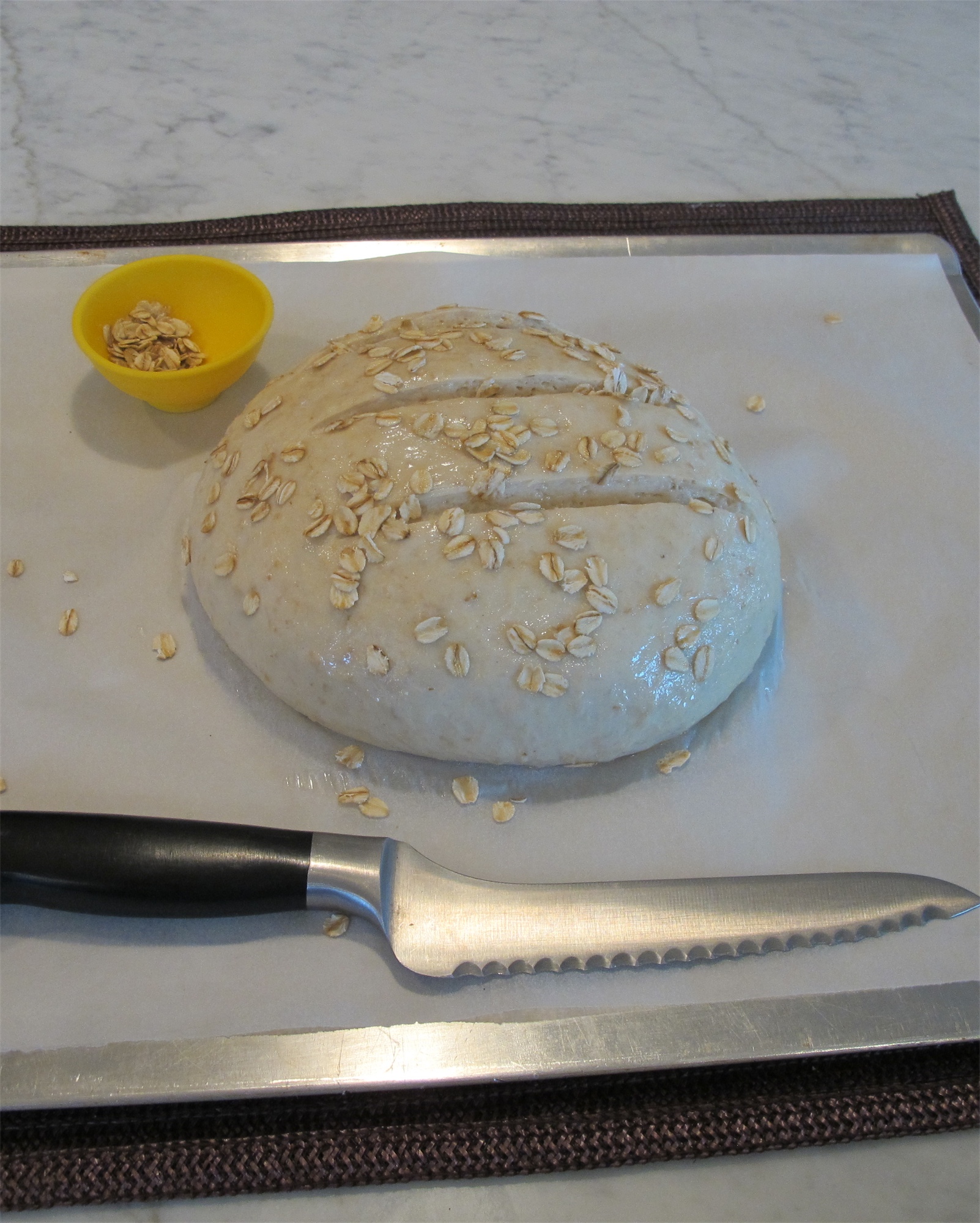
After the dough has been rising for 1/2 hour or so, preheat the oven to 350 degrees. When the oven comes to temperature and the total rising time is between 50-60 minutes, brush the top of each loaf with beaten egg white mixed with a about 1 tsp of water. Sprinkle tops with some oat flakes, and rebrush with the egg white mix to keep the oatmeal flakes from falling off.

Ready for the oven!

Bake ½ hour at 350 or until internal temperature registers 190 degrees. Let cool for 5 minutes, then gently shake the bread and remove to a rack, leaving the loaf on it’s side. Wait at least 20 minutes before slicing into the loaf and do not put in plastic wrap or freeze for at least 4 hours so the internal temperature is cool.

NOTE: You can use 1 cup of whole wheat flour in place of 1 cup bread flour, and can make ½ recipe in you don’t want two loaves.  In these pictures I made a free form round loaf without a bread pan which works as well.

Share
Posted in Breads, North America | Tagged , , | 2 Comments