
Click here to view recipe.
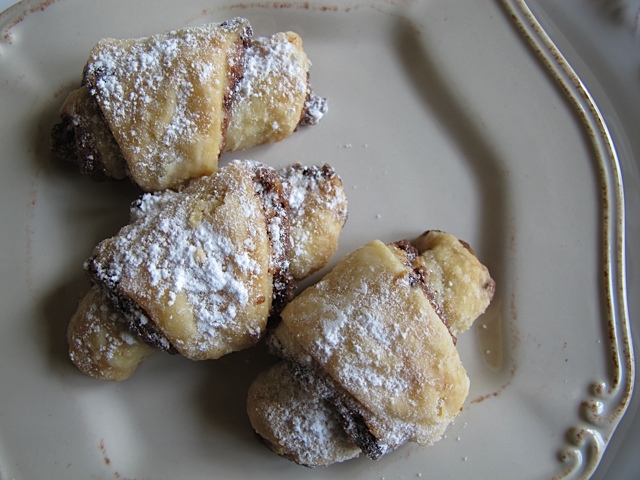
Rugelach
I got a phone call from my daughter Rachel last weekend. She had been reviewing my recipe for crescent shaped rugelach on her computer but the directions were terrible and the ingredients for the filling weren’t correct either. Unfortunately my recipes are cursory at best with little detail because I cook from memory most of the time. “Mom,” she said “If you don’t want your recipes to die with you, you really need to write down or videotape exactly what you do.” Hmmmm… Food for thought (forgive the pun!).
My mother was an excellent baker but never made rugelach. When I moved to Seattle in 1980, I met Anita – another young mother who lived two blocks away. Her son Eli was Rachel’s age (3 at the time), they became best buddies and still are great friends to this day. For the next 30 years Anita and I had a baking date with each other.
Anita and I were a team. I must say that she was, and still is, way more precise than I and always had her ruler out so she could cut everything just so. Our 5-hour long baking days provided us with time to catch up with each other’s lives and ended with enough pastries and cabbage rolls to feed an army.
Rugelach is actually a Yiddish word; they have been around since the 1800’s and are Eastern European, perhaps Viennese, in origin. They have a butter and cream cheese dough and can be filled with poppy seeds, jam or dried fruit filling. The initial recipe for this cookie was Anita’s and it was made with mini semi-sweet chocolate chips and much less filling than I use today. I always place the chocolate mixture inside as written below rather than the more traditional fillings. They are exotic in appearance, fairly easy to make and nearly fail-safe. The dough is very forgiving, too. These cookies never fail to impress and are a lovely gift to package when I am invited to dinner at someone’s home or when one of my friends has a birthday. Along with a cup of tea, they are sweet but not too sweet, beautiful to behold and they inevitably satisfy my own chocolate cravings.
So no worries, Rachel, Daniel and Jake (my kids). This recipe will live on forever in cyberspace! Now I have to get busy and document the other special things you love. Send me your lists!
PS: Some of you readers are probably shaking your heads because there isn’t a whole lot in these rugelach that is good for you. Cream cheese, butter, white flour, granulated sugar… But one or two occasional treats like these certainly won’t hurt you. Believe it or not, my entire family eats healthful food 85% of the time, and when they indulge in rugelach it isn’t something they devour at one sitting. The cookies are too rich and filling for that!
Rugelach
Yield: 48-64 pieces (I make bigger one now so I do 48, or 12 wedges per ball of dough.
Ingredients for the dough:
- 8 oz regular cream cheese
- 2 sticks softened butter
- 2 tsp pure vanilla extract
- 2 1/3 cups all purpose flour (+ more for rolling them out)
Ingredients for the filling:
- 1/2 c sugar
- 1 cup c walnuts
- Heaping ¾ c bittersweet chocolate chips (Ghirardelli is my favorite)
- 1 tsp ground cinnamon
- 2 Tbsp melted butter (optional)
Instructions:
Preheat oven to 375 degrees.
Put flour, cream cheese, butter and vanilla in a Cuisinart. Pulse until combined and stop when dough starts to stick together – do not over process. Remove carefully from the food processor; the dough should still be sticky. Refrigerate at least 2 hours or up to a week. I have even frozen the dough for a month and it is just fine.
You don’t need to wash the food processor! Just pulse all filling ingredients except butter in the Cuisinart together until pretty finely chopped. Remove to a bowl and stir in the melted butter. Again, I have successfully frozen the filling for 2 months but if you do this, let it come to room temperature the day you plan to bake.
Remove dough from cold refrigerator about 15 minutes before you want to bake the cookies. Divide dough into fourths, and roll each fourth into a smooth ball on the counter with a little flour on your hands.
Use a large floured cutting board. Flatten one dough ball into a 3 inch disc, then use a lightly floured rolling pin to roll this ball of dough into a 9-10 inch circle. I get a little compulsive here and actually trace ½ inch larger than an upside down 8 inch salad plate to make a perfect circle. (see photo)
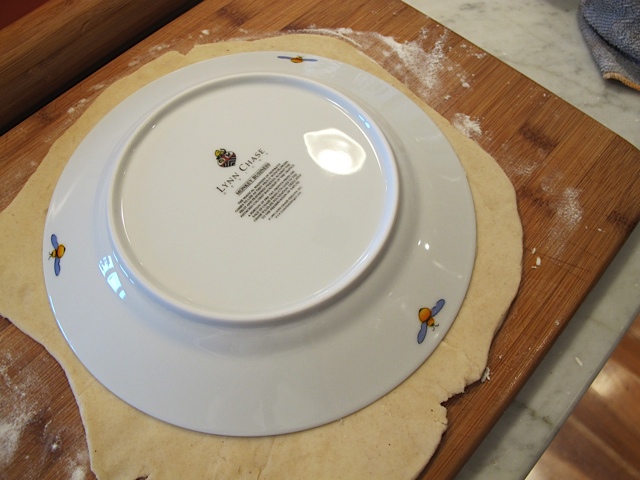
Dough shaped with salad plate
Put ½ cup of filling in the center of the round circle you have just rolled and spread the filling evenly to the outside edges. With your index finger clear out the center of the circle (1 inch or so) so there is no filling there.
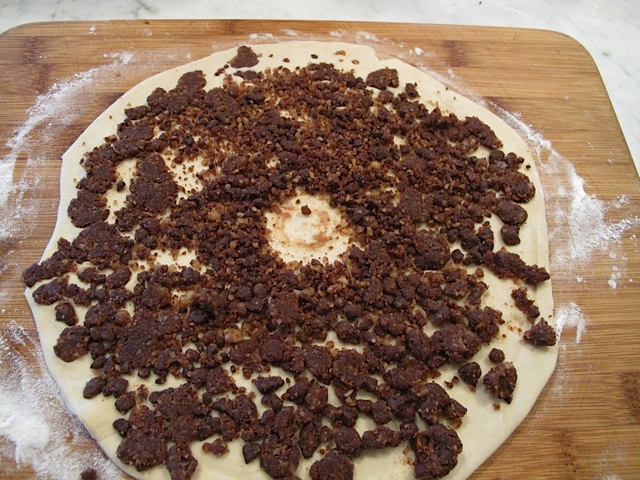
Dough topped with filling – hole created in the middle
Press the nut topping into dough with your palms or lightly roll it so it sticks to the dough with your rolling pin. Using a pizza cutter or a knife (I like the pizza cutter) cut into 16 pie shaped wedges. Cut the circle in fourths, then the fourths into ½ and so on. (I know this is too much information, but you kids wanted the details!) Roll from the outside or large part of the circle to the center point without filling.
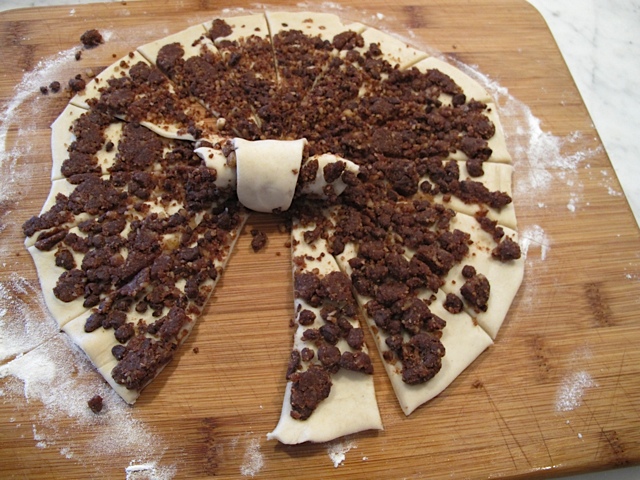
Rolling the dough with the filling
Tuck the point of the crescent wedge underneath the cookie and place on a parchment-lined cooking sheet. They should be one inch apart because they do puff and spread as they cook.
Bake at 375 for15-20 minutes or until barely golden. Cool on the cookie sheet for 15 minutes.
Sift powdered sugar on top when cooled. These freeze very nicely for 2 months. Re-sprinkle with powdered sugar when serving them – it covers up any errors and make the rugelach look quite professional. Enjoy!
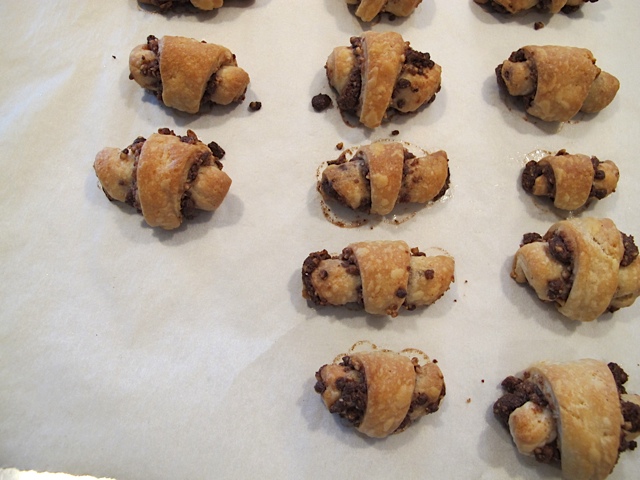
Fresh out of the oven!